There is a pattern in how most organizations adopt process management software. Someone decides that processes need to be formalized. A project team is assembled. Consultants may be involved. Months of workshops follow - interviewing stakeholders, drawing BPMN diagrams, debating edge cases, writing documentation. Eventually a subset of the processes is modeled. Then another team translates those models into executable workflows. More months pass. By the time employees can actually use the result, the original process may have already changed.
This is the approach NIVO was built to replace.
Describe It Once, Get a Working Workflow
A department head who has never drawn a BPMN diagram can describe how a procurement approval works - in plain language, in a meeting summary, in an existing Word document. NIVO takes that input, asks targeted clarifying questions, and produces a fully modeled process. It then asks directly: should this become a live workflow? If yes, the workflow is built and ready for employees to use from their dashboard.
The difference to traditional tools is the direction of work. You do not build a process model and then ask the system to run it. You describe what you need, and NIVO delivers a working result. You step in to review, adjust, and approve - not to build from scratch. The heavy lifting is done before you touch anything.
In our first test phase, this turned a process that would traditionally take half a year to document and formalize into something that was modeled, built, and ready in a single day.
What Happens When You Bring In a New Process
There are three ways to start:
Natural language. You describe the process the way you would explain it to a colleague. How does a travel reimbursement work? Who approves what? What happens when the amount exceeds a threshold? The AI listens, structures what you said, and asks follow-up questions where the description is ambiguous or incomplete.
An existing document. Most processes already exist somewhere - in a Word file, a PDF, an internal wiki page, a shared drive. Upload it. The AI parses the document, extracts the process steps, identifies roles and decision points, and builds a structured model from it.
A BPMN file. If you already have formal process models, import them directly. NIVO reads the BPMN, validates it, and flags issues - missing escalation paths, dangling gateways, steps without clear ownership.
Regardless of how you start, what follows is the same: a short conversation with the AI. It asks clarifying questions - not dozens, just the ones that matter. What is the SLA for step three? Who should be notified when a request is escalated? Does this step require a specific approval role? After a few rounds, you have a modeled process.
Then the AI asks: should this become a workflow that employees can start? If you say yes, it builds the workflow - forms, routing, notifications, all of it. The workflow appears in the service catalog, ready for anyone in the organization to use.
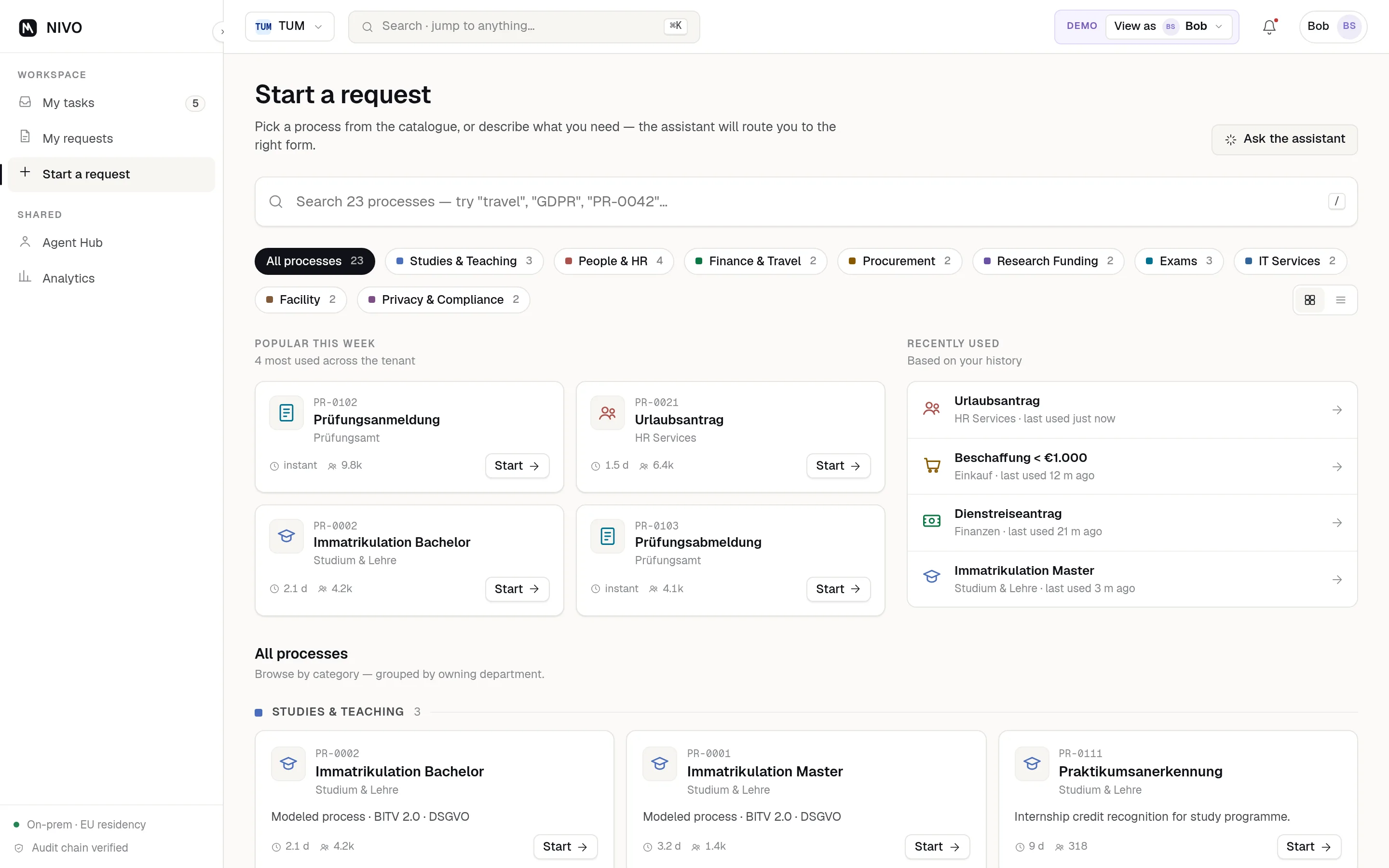
If something is not quite right - a form field needs a different label, an approval step should go to a different role, a notification is missing - you make the adjustment manually. Small changes, not a full rebuild. The AI built the 90%. You handle the 10%.
What Each Role Actually Sees
One of the design principles behind NIVO is that complexity should not be visible to people who do not need it. Every role sees a different interface, reduced to exactly what that role needs. Nothing more.
Employees
An employee sees a simple dashboard. Open tasks that need their attention. Requests they have submitted and their current status. A service catalog where they can search for and start any workflow available to them.
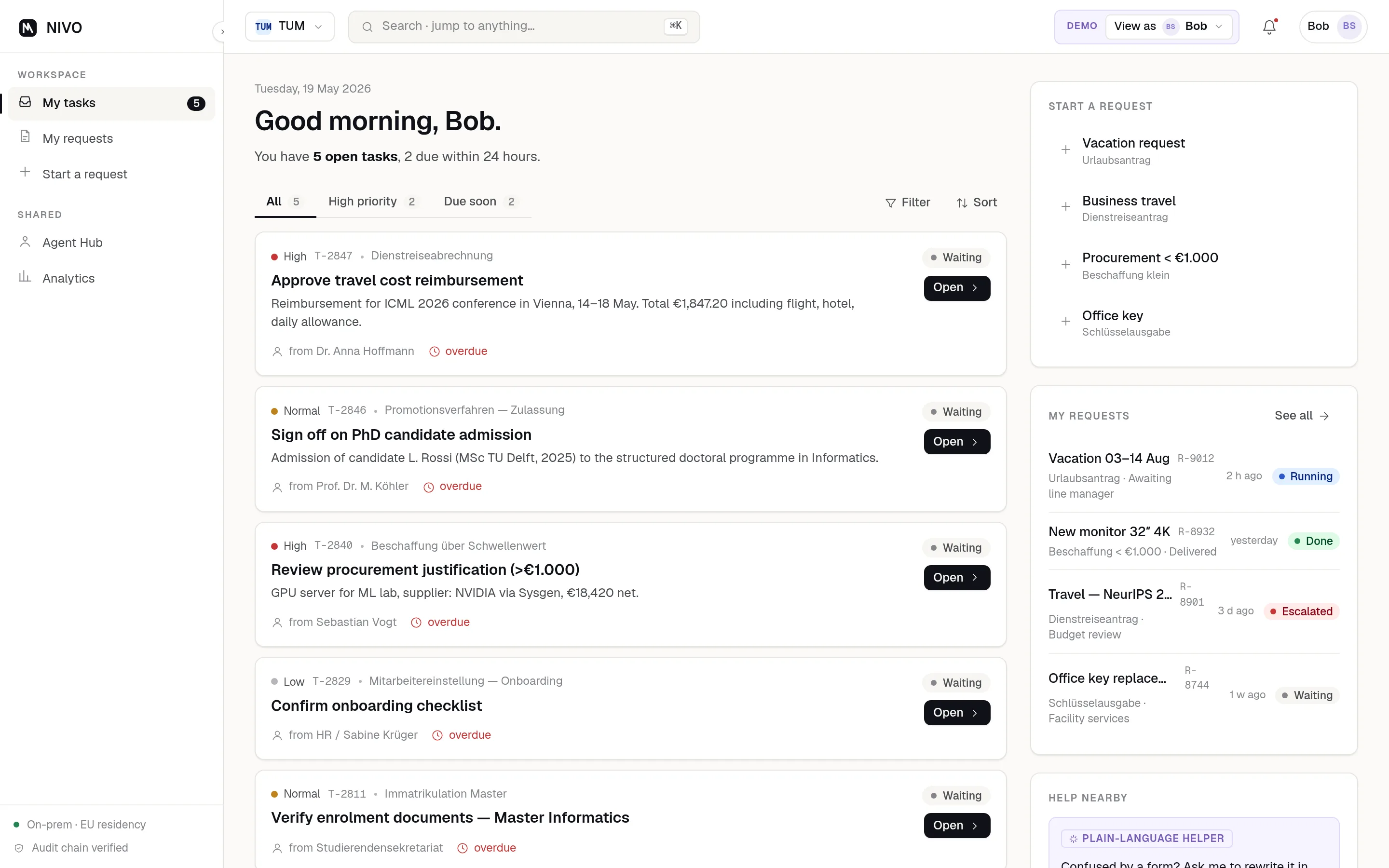
That is it. No process models, no BPMN diagrams, no configuration panels. An employee does not need to understand how the process was built. They need to find the right workflow, start it, fill in what is asked, and track where their request stands. NIVO keeps this surface radically simple because adoption depends on it. A tool that people avoid because it is overwhelming solves nothing.
When an employee opens a task - say, approving a travel reimbursement - they see the relevant information and an AI-generated compliance summary. Receipts checked, thresholds flagged, regulations referenced. The employee makes the decision. The AI did the preparation.
Process Managers
A process manager or department head sees the process workspace. This is where processes are created, monitored, and improved - but even here, the AI does most of the structural work.
The process list shows every process in the organization with health scores, version history, run counts, and compliance status. Selecting a process shows its visual structure - every step, decision point, and escalation path. On the side, the AI highlights what could be improved: missing SLAs, implicit routing, ambiguous decision criteria. It does not just flag problems. It proposes specific fixes and can apply them with your approval.
The key insight is that process managers do not need to be BPMN experts. They need to understand their domain - how procurement works, what the onboarding steps are, which regulations apply. NIVO handles the translation from that domain knowledge into a formal, executable process.
Analytics
For leadership and controlling, NIVO provides an analytics view with AI-generated narrative summaries - not just dashboards with numbers, but written explanations of what is happening. Which processes are stalled, where bottlenecks are forming, what changed since last week.
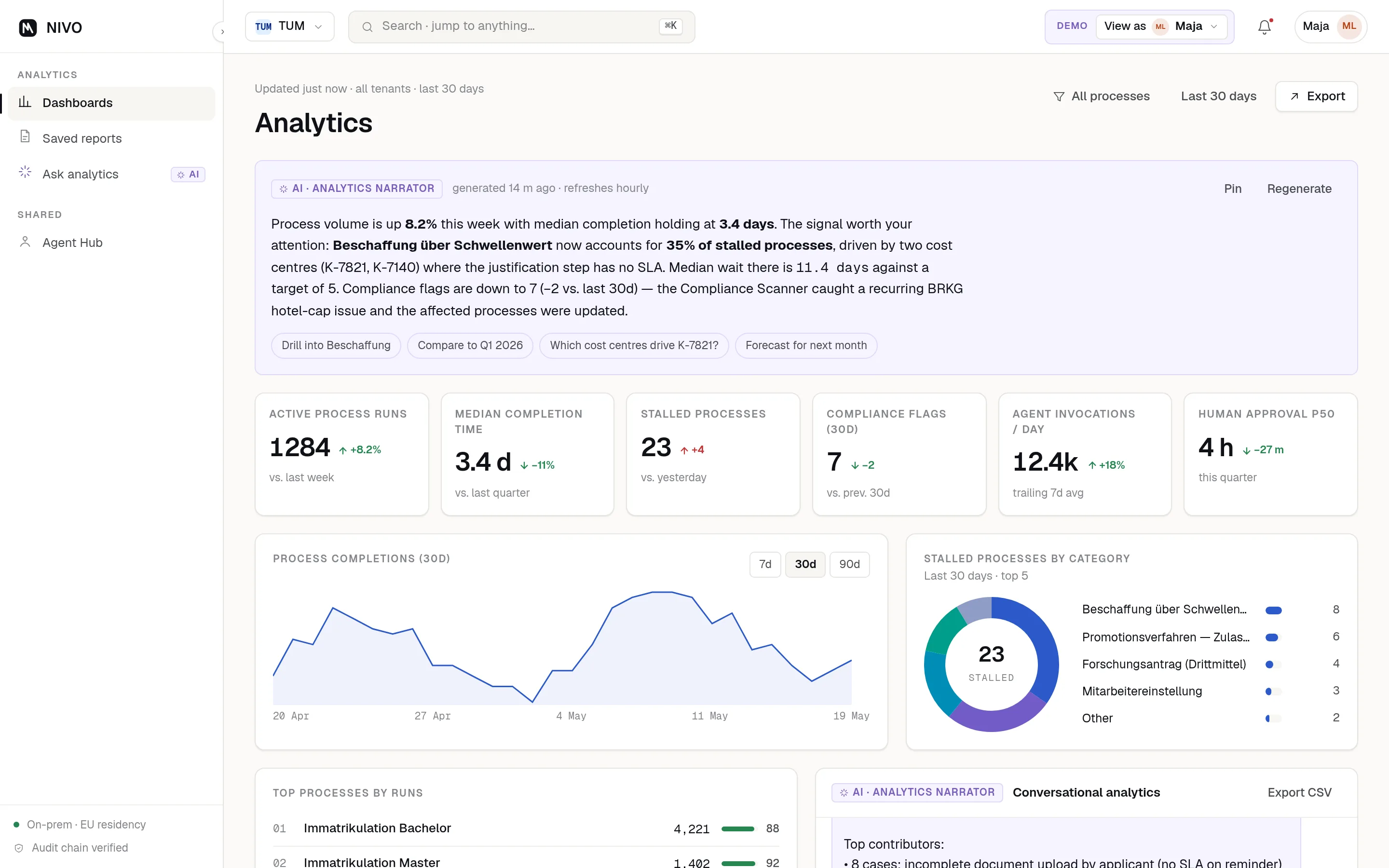
Questions can be asked in natural language. The answers are grounded in the actual process data, not generic advice.
Compliance Is Not a Separate Step
In traditional process management, compliance checking happens after the process is designed - often as a separate audit. NIVO integrates compliance from the moment a process is first described.
When the AI models a process, it checks against applicable regulatory frameworks - GDPR, BITV 2.0, BRKG, VgV, and sector-specific rules. It also reads internal organizational documents you provide: policies, guidelines, operating procedures. If a process step conflicts with a regulation or an internal rule, the AI flags it during modeling, not after deployment.
This means that by the time a process manager reviews the AI's output, compliance issues have already been surfaced. The process that gets published is not just functional - it is compliant by design.
What Is Under the Hood
NIVO is multi-tenant, role-based, and hosted in the EU with full data residency. On-premise deployment is possible but not the default - the platform is designed to work out of the box as a hosted service. The AI capabilities are structured as specialized components - one handles document intake, another manages clarifying conversations, another scans for compliance, another generates forms from process definitions. Each works within its domain, and every action that changes state requires human approval.
The platform maintains a hash-chained audit log for complete traceability. RBAC with tenant isolation supports multi-organization deployments. A developer API with OpenAPI documentation allows integration with existing systems.
Where We Are Now
NIVO is in intensive development. We are building, testing with real institutional processes, and iterating fast. The screenshots in this post are mockups from our demo system with sample data - they show the interface as it is being built, not real organizational data.
If your organization spends months turning process knowledge into working workflows, that is the gap NIVO closes.
We would like to hear about your processes. Not to sell you a roadmap, but to understand whether what we are building fits what you need.